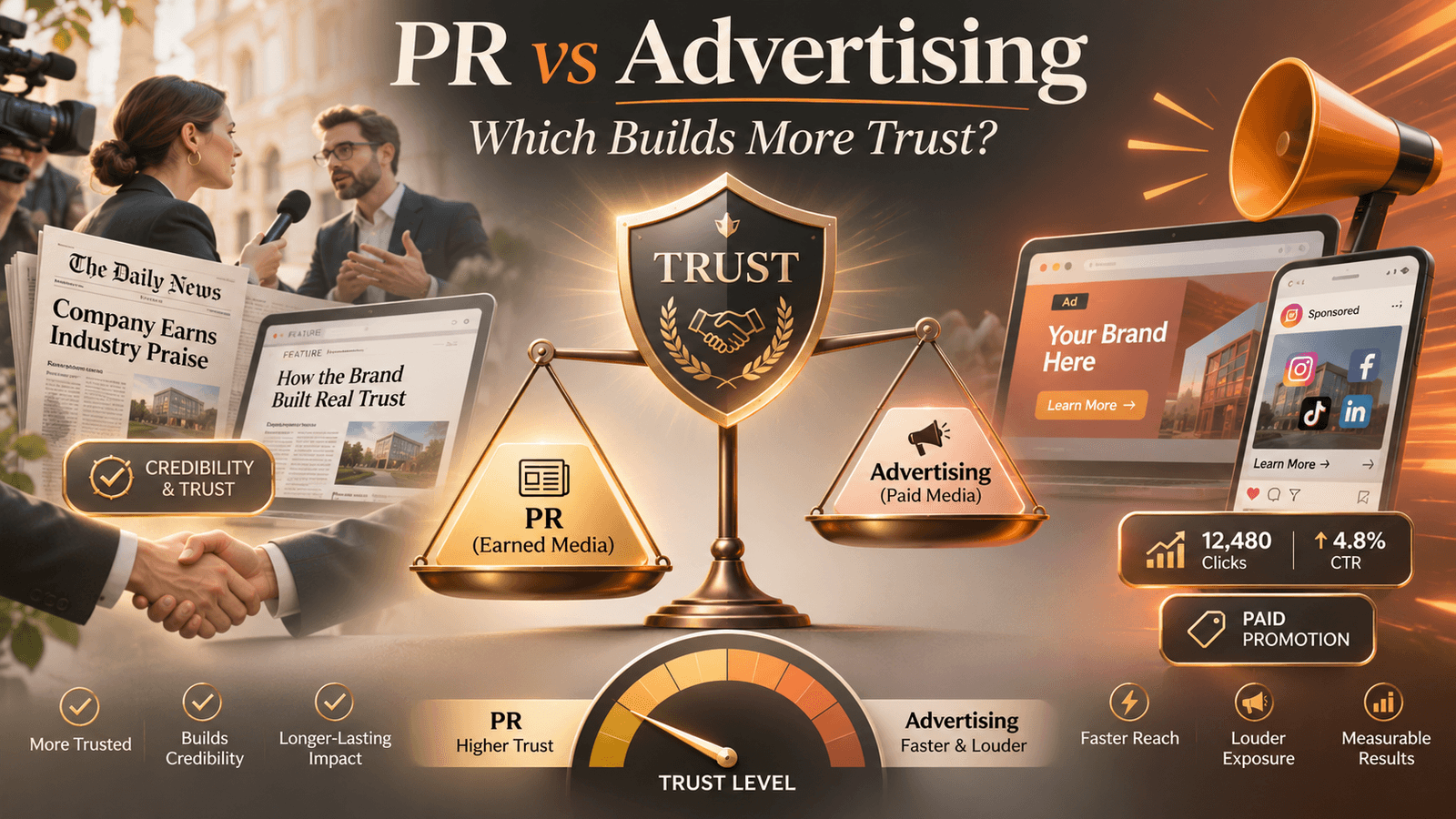
Every marketing meeting eventually hits the same question: where should the next portion of the budget go? The PR vs. advertising debate is really about trust. Ads buy attention quickly, but attention isn’t belief. This article looks at what each channel does well, what the data says about credibility, and how a real campaign shows the difference.
Why Trust Decides the Sale
Trust now sits right next to price and quality. Edelman’s 2026 Trust and Brands findings show that 88% of consumers call trusting a brand an important or critical purchase criterion, on par with quality (89%) and value (88%). The same report notes that almost half of people globally don’t trust brands, or don’t find them relevant, or both. Any channel that claims to build trust has to work against that scepticism.
What is earned vs paid media?
In earned vs paid media, the difference is simple. With advertising, you pay for space and say whatever you like. With PR, a journalist, analyst or expert decides whether your story deserves attention, and the audience knows it. You give up control and gain credibility. That is the core of PR vs advertising.
Side-by-Side Comparison
Factor | PR | Advertising |
|---|---|---|
Who delivers the message | Third party (media, experts) | The brand itself |
Control over wording | Low | Full |
Cost model | Retainer or project fee, no media purchase | Pay per placement, impression or click |
Speed | Slower, builds over months | Fast, live within days |
Shelf life | Long, coverage stays searchable | Ends when spend stops |
Perceived credibility | High | Moderate to low |
How Does PR Work?
PR is about finding relevant stories, building brand credibility and reaching the right audience through strategic media coverage.
Identify a Newsworthy Story
A successful PR campaign begins with identifying a brand story that connects with its target audience and reflects market demand. For example, Media Mantra positioned AUM Development as a growing player in Dubai's competitive real estate market through the launch of Veda, its residential project in Jumeirah Village Circle (JVC). The campaign highlighted the project's launch and its relevance to Dubai's evolving residential property landscape, generating interest among property buyers, investors and industry stakeholders. The campaign secured 18 media placements across leading UAE and regional publications.
Build Credibility Through Media
Building credibility means creating trust and confidence in a brand through consistent communication and positive media coverage. For example, Media Mantra strengthened AUM Development's credibility through strategic media outreach, securing coverage for Veda's launch in UAE publications such as Khaleej Times and Al Bayan, alongside industry platforms like Gulf Property and ME Construction News. This coverage helped AUM Development reach relevant audiences, improve its visibility in Dubai's property market and strengthen awareness of its residential offering among potential buyers and industry stakeholders.
What is Advertisement and its examples?
Advertisement is a paid form of communication used by businesses to promote their products, services or ideas to a target audience. In the UAE, brands use television, social media, billboards and newspapers to reach potential customers. For example, an Emirates Airlines TV commercial, a Dubai Mall promotional campaign or a real estate advertisement for a new property in Dubai are common examples of advertising.
What the Data Says About Trust
The numbers point the same way. Edelman found that 41% say what people not paid by a brand say about it has the biggest impact on their trust, compared to 20% who cite what the brand says about itself. Nielsen’s global study found that 92% of consumers trust earned media, such as recommendations from friends and family, above all other forms of advertising. Paid formats scored lower, as the table shows.
Source | Finding |
|---|---|
Edelman 2026 | 41% trust what unpaid third parties say most, vs 20% for what a brand says itself |
Nielsen Global Trust in Advertising | 92% trust earned media above all other forms |
Reuters Institute 2026 | Overall trust in news at 37%, the lowest the study has recorded |
The last row is a useful warning. Earned coverage is only as strong as the outlet behind it, so where your story appears matters. Even so, the case for PR vs advertising on trust is clear.
Where PR Sits Among Marketing
PR vs marketing is a common mix-up. Marketing is the whole machine: research, pricing, product, distribution and promotion. PR is one part of it, focused on reputation and relationships with media, investors, employees and communities.
Advertising vs publicity is a narrower split. Publicity is coverage a brand receives, often from a single announcement or event. Advertising is a message a brand pays to place. PR is the wider, longer discipline that plans publicity and ties it to a reputation strategy.
Where PR Earns Its Keep
The Real Advantages
The benefits of PR go beyond a headline. Coverage lends borrowed credibility, supports search visibility, gives sales teams something third-party to point to, and cushions a brand when something goes wrong. It also compounds. An article published today can still be shaping opinion a year later.
The Right Moments
Knowing when to use PR saves budget. It works best for launches of new or unfamiliar products, founder and leadership positioning, entering a new city or country, funding and partnership announcements, and crisis communication. Complex offerings, such as fintech, healthcare or B2B services, benefit most because they need explaining.
When Advertising Is the Better Tool
If you need immediate sales for a sale, a seasonal offer or a retargeting campaign, advertising is faster and easier to measure. It is also the only route when you must control the exact message.
Use PR and Advertising Together
The smartest answer to PR vs advertising is usually “both, in order.” Use PR first to build credibility and give people something real to read. Then let paid media amplify that coverage to a wider audience.
Conclusion
The PR vs advertising debate is not about choosing one over the other but understanding how they complement each other. Advertising captures attention quickly, while PR builds credibility through authentic third-party validation. In an increasingly sceptical market, trust can be the deciding factor in consumer choices. The most effective strategy combines both channels: use PR to establish a credible brand reputation and advertising to amplify its reach. Ultimately, attention may attract customers, but trust is what helps build lasting relationships and long-term brand loyalty.

Reader comments